
On this page
Your needs, this model
Does it fit your priorities?
Is heated warm mist required alongside a supported ultrasonic plan?
The newer linked 2025 manual identifies both warm and cool ultrasonic mist.
Explore this need in the finder →Do you require Automatic response and a selectable upper humidity target of at least 75%?
The newer manual describes Auto and a 40–80% target range in 5% increments.
Explore this need in the finder →Can an unconfirmed capacity satisfy a strict 4.1 L minimum?
Capacity differs across the page and linked manuals; an optional tank limit may be left open, but a required minimum must not be treated as satisfied.
Explore this need in the finder →Do you need a separate oil pad rather than tank additives?
The newer manual gives an aroma tray and prohibits essential oils in the tank or base.
Explore this need in the finder →Is a physical remote needed, while app control is not?
The exact model manual identifies an included remote that mirrors panel functions; no app control is documented.
Explore this need in the finder →Can an unknown warm-mist output rate meet your numeric minimum?
The manual states warm-up time and nozzle temperature but no mL/h warm-mist rate. The exact numeric output remains unknown and cannot satisfy the requested minimum.
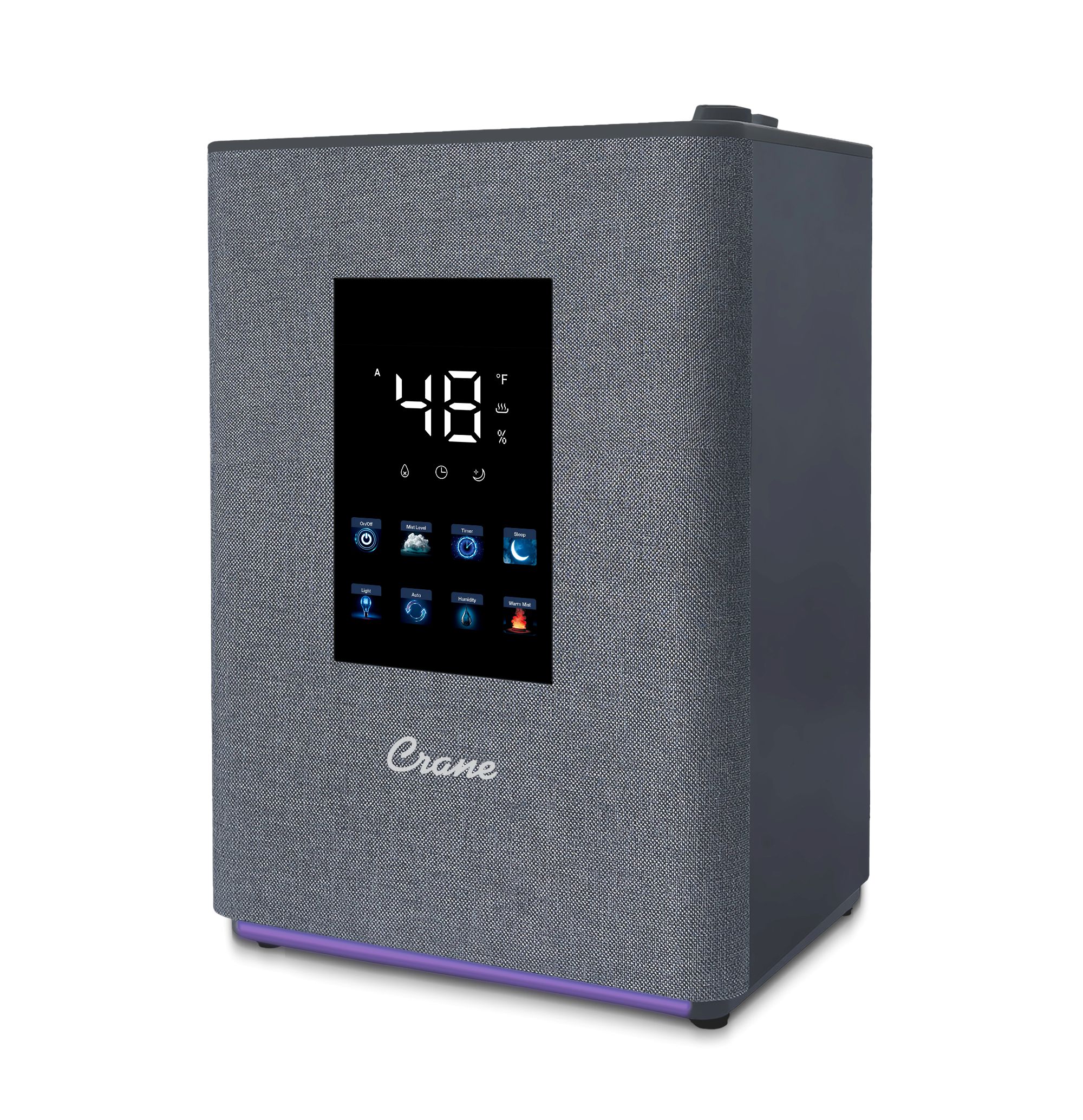
Explore this need in the finder →The Crane EE-6913 combines top-fill ultrasonic cool and warm mist, a selectable humidity target, Auto output adjustment, a one-to-twelve-hour timer, handheld remote and a separate aroma-pad tray. Its useful difference from a cool-only model is not just heat: the newer linked manual describes both a 40–80% target mode and output that changes with room humidity. Its tank capacity, however, cannot be treated as settled. Crane’s exact page title and 2021 manual say 1.2 gallons; the newer 2025 black-unit manual says 1 gallon / 4 liters.
Warm and cool operation with a choice of control modes
The EE-6913 starts in manual mode. You can choose among three mist levels, turn on warm mist, use the timer, or select Auto. In the newer 2025 manual, Auto changes output according to the reported humidity: high below 45%, medium from 46–65%, low from 66–80%, then off above 80%. A separate humidity mode lets you choose 40–80% in five-point increments and cycles mist when humidity drops below your selected threshold. The manual describes a built-in reading and an operating response; it is not an independent humidity sensor calibration certificate or a promise of uniform conditions across the room.
Warm mist takes time: Crane says to allow about 20–30 minutes for the output to warm and describes it as around 40°C at the nozzle, not hot steam. The manual’s specification table lists 110 watts and up to 24 hours per tank, without dividing runtime by warm/cool setting. It also lists up to 500 square feet and noise below 35 dB(A). Those are maker-supplied limits, not measurements from this review. If the expected warm-mist output rate is essential, the manual provides no milliliters-per-hour rating.
Resolve the version conflict before you rely on tank size
Crane’s product page identifies the model as a 1.2-gallon tank and links two manuals labeled as newer and older versions. The older 2021 guide says 1.2 gallons; the newer 2025 manual for a black unit specifies 1 gallon / 4 liters. Both give up to 24 hours and up to 500 square feet, but they describe different controls. The old guide includes a Baby mode and UV-light and ionizer functions. The newer guide’s panel and features instead describe Sleep, Auto, selected humidity and warm-mist controls, without those older Baby/UV/ionizer modes. This assessment uses the new manual for the current operating plan and does not carry older-version functions forward.
Because the exact page continues to link both revisions, a buyer looking at an offer should check the model label and supplied instructions before treating either capacity as certain. We leave the tank-size fact unknown: it cannot meet a strict 4.1-liter minimum in the questionnaire when the sources disagree. This is a specification conflict, not a doubt that the page’s EE-6913 identity matches the model family.
Aroma-pad use and the filter distinction
The newer manual identifies a separate aroma tray with a pad and says not to pour essential oils into the tank or base. That is a clear separation between fragrance and water. It also lists a ceramic filter and a HEPA filter used for air passing through the appliance. The manual expressly says the HEPA part does not make the EE-6913 an air purifier for an entire room. Avoid treating that component as a substitute for a room air cleaner or as evidence that the unit has been independently tested for air quality.
Daily emptying and air-drying of the tank and base, weekly vinegar cleaning and ceramic-filter care after every thirty fills or when dirty make this a more involved choice than a simple ultrasonic bowl. The warm-water path and filters add steps. No exact dishwasher-safe components are identified in the newer manual, so assume hand cleaning unless the instructions supplied with a verified offer say otherwise. Use fresh cool water in the tank, keep oils out of it, and do not move the appliance while full.
Who should compare it—and what the alternatives change
The EE-6913 is the Crane to compare if warm and cool options, a target mode, remote and aroma pad all matter. The EE-6917 is a cool-only tower with a documented 8-liter tank and a water-tank UV-A feature, but it does not supply a room-area rating in its reviewed evidence. The EE-6909 is simpler: cool mist, two levels and a larger single stated 1.2-gallon capacity than many compact models, but it lacks a timer and humidity control and has its own direct-oil wording conflict. Which is preferable depends on whether heat, tank certainty, large capacity, cleaning simplicity or automated control is essential.
Choose the EE-6913 for its documented newer warm/cool control plan only if the particular version is confirmed and its care routine suits you. Do not rely on a 1.2-gallon claim, old-version Baby mode, UV or ionizer for a current offer without checking its label and guide. This is a source-based assessment of Crane’s exact product page and both linked model manuals, not an ownership report, health recommendation or independent room test.
Key details at a glance
| Maker-stated room-area range | 500 sq ft maximum |
|---|---|
| Maker-stated runtime wording | The newer manual lists up to 24 hours; the older 2021 manual also lists up to 24 hours, without setting-specific runtime. |
| Top-fill design | Yes |
| On-device controls | On-device buttons and display |
| Automatic humidity adjustment | Yes |
| Phone app control | No |
More specifications and setup details
| Manufacturer-documented oil route | Separate aroma pad |
|---|---|
| Essential oils permitted in the water tank by this manual | No |
| Maker-documented color-changing tank light | No |
| Separate aroma-pad route | Yes |
| Heated warm-mist mode | Yes |
| Included physical handheld remote | Yes |
| Listed power rating | 110 W |
| Humidification method | Ultrasonic |
| Selectable humidistat target | Yes |
Use the exact model’s instructions for operating limits, supplied equipment and version differences.
Paper, software and setup details
Manufacturer noise claim
Both manuals list below 35 dB(A); manufacturer figures without independent measurement conditions.
Manufacturer cleaning interval
Empty the tank and base daily and air-dry; weekly vinegar cleaning. Clean/activate the ceramic-ball filter after every 30 tank fills or when dirty per the newer manual. HEPA/filter details are not an air-cleaning promise for a room.
Sources for this assessment

Choose around the real routine.
Compare water capacity, fill design, humidity controls and the care instructions for the exact model.